
Mother Song

I
“The thought of origins soothes us, whereas that of the future disturbs us.”
Roland Barthes, Camera Lucida.
“Suddenly the mask vanished: there remained a soul, ageless.”
Hervé Guibert, Ghost Image.
“My mother… as perennial as the winter, as ancient as the bison.”
Guy Maddin, My Winnipeg.
II
If you listen closely there on that water, a mist is turning to song. It is dusk, some eternal dusk, and you cannot leave. There’s something in this dusk reminiscent of a vision I had. Each atom in my body as a galaxy, dying, stars burning-up, explosions. It was a goodbye. It was almost silent. The mist plays a silent instrument, an echo in plainsong. If you listen closely, you can hear she’s been singing goodbye forever.
III
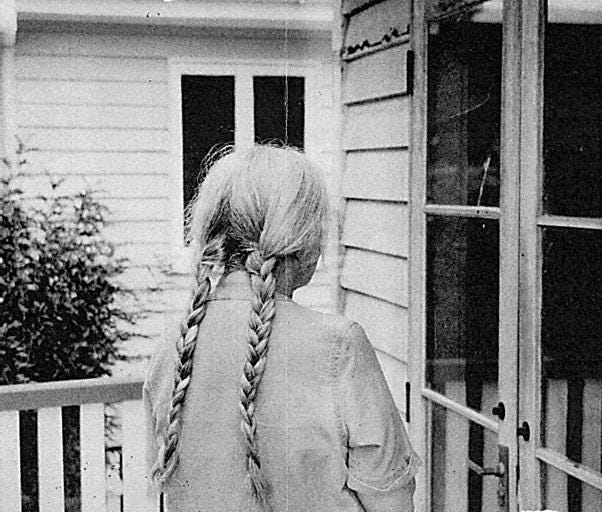
I have collected these thoughts as a way out of a torpor, a state of complete aesthetic stuntedness. In Australia, a whole visual language presented itself to me with ease. I took dense, gritty pictures of the ramshackle house in which I grew up, its broken doors and wainscoting; the creeks where I sought privacy in my teenage years, the run-down suburban-scapes which served as stage to the various dramas of my young life. And my Mother, my white-haired, dreamy, peasant-smocked Mother. A version of my Mother. A version of her living in my mind, in my narrative arc. A version, I suppose, of me.
To recognise my Mother from my pictures of her is not to recognise her in her fullness.
What might I write about my Mother, or her character, her peculiarities, her essence? I might write any number of things, might in fact be writing them forever, except that this isn’t exactly the thing I am attempting to mine here: I am thinking, almost, of the folklore of the Mother, of Mother as figure in work. Mother as player.
I don’t know that any amount of work made about my Mother would do her character justice. Photographic subjects, much like their literary counterparts, are reduced to character. All work is auto-biography. Every portrait of the artist’s mother is a self-portrait.
IV
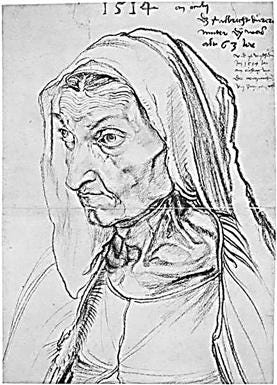
Portrait of the Artist’s Mother at the Age of 63.
Albrecht Dürer, 1514
In 1514, Albrecht Dürer completed a charcoal study of his aged Mother. “Aged” here is relative, she was only sixty-three, yet she carried centuries on her face. She died only months after the completion of the portrait.
Barbara Dürer was described by her son as a pious woman, who “often had the plague… suffered great poverty, scorn, contempt, mocking words, terrors and great adversaries. Yet,” he writes, “she bore no malice.”
In rough veil and furrowed brow, Barbara Durer is resolute and staunch. Her gaze has been noted for its “existential piety.” Her eyes are cast outward, in opposite directions. A mountain-goat of a Mother, her vision tilted heaven-ward.
The artist Hervé Guibert wrote, in his book Ghost Image, of photographing his Mother, “There she sat, majestic, like a queen before an execution. (I wonder now if it wasn’t her own execution she was expecting, for once the picture was taken… the process of aging would continue.”
I am reminded of this when looking at Barbara Dürer. I am aware that her aging did not continue. I am aware that I am looking at a woman who, according to her son, “died hard.”
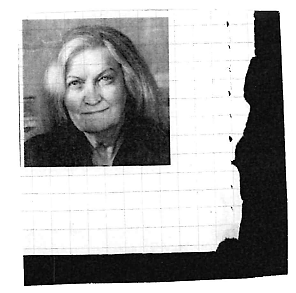
I have countless times had my own Mother sit before me, expectant, a doomed queen facing the tripod. I have been, then, executioner.
Here, stay, says the silver, some alchemical spell.
V
There is a cave somewhere, across the misty loch, with muddy walls. Inside the cave there is a ghost. She has long silver tresses like garlands of steel wool. She is fussing on the dirt floor, sorting through stacks of sticks and reeds. She is sighing and swearing with frustration. Light a candle in this cave, and be kind to her.
VI
There has been much discussion of Barbara Durer’s eyes. Of her death, her son wrote:
“I marked that she saw something dreadful, for she asked for the holy-water, although, for a long time, she had not spoken. Immediately afterwards her eyes closed over. [I saw] how Death smote her two great strokes to the heart, and how she closed mouth and eyes and departed with pain. I repeated to her the prayers. I felt so grieved for her that I cannot express it.”
Had photography existed then, in 1514, might Durer have photographed this?
Guibert refers to his Mother portraits as “an unhealthy and funereal undertaking.”
Sometimes mightn’t it simply be beauty, a spell? Is that enough?
VII
There are six people in the house. Three children, two women, and a ghost. When the children were smaller, the ghost jostled a figure of porcelain off a bookcase, and the children laughed. Other times, the ghost played Elvis on the radio, disrupted the kitchen appliances, and sat on the ends of beds at nightfall, its body weighty, causing blankets to smooth and furrow like grasses where animals nest.
When the mother is awake, in the early hours of the morning, she washes dishes in a tub which she must carry out to the laundry for running water. She stands over the running water, so exhausted that she nods off, still standing, like a spent horse in its stable. She is very tired, and forty-five, and says often that she feels as if she’s being dragged through the years, slowly, methodically, with no end in sight.
She doesn’t say this to the children, she says it in letters to friends, and on the phone, three boys listening on the other line, holding breath so that she can’t hear them. When the phone bill comes, she cries, and the men from the company are not sympathetic, and the little boys know that if the phone company calls they should not answer the phone, or mummy will have to close herself in her bedroom. Rips are beginning to appear on her faded purple peasant dress. It smells warm and like soap, and skin, and very vague half-memories of cradling.
VIII
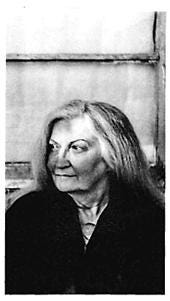
“I never recognized her except in fragments, which is to say that I missed [her] altogether. It was not she, and yet it was no one else. I would have recognized her among thousands of other women, yet I did not “find” her.”
Roland Barthes, Camera Lucida.
IX
Where mist becomes bird there is a vapour waving goodbye.
I am singing your song back to you.
It is shimmering in mist. The mist sings and sons listen. We listen through veins and veils.